PART ONE: CONTEXTUALIZATION AND WHAT IS PRAXIS?
Over the next month, I will be sharing and extrapolating on the presentation I created for the University of Minnesota’s 2024 Enhancing Quality Staff Library Symposium. I hope that the information is helpful to you. Make sure you are signed up to receive notifications of my posts!
Before we begin, I want to extend a big, warm thank you to Josh and the team at the University of Minnesota for thinking of the Quatrefoil Library and giving me the opportunity to share my ruminations at the very busy intersection of the history of the Quatrefoil Library, censorship and specifically self-censorship, the value of really exploring “what is a book”, and how to create a self-censorship resistance praxis.

What is Praxis
Praxis is the process by which a theory, lesson, or skill is enacted, embodied, realized, applied, or put into practice. “Praxis” may also refer to the act of engaging, applying, exercising, realizing, or practicing ideas. This has been a recurrent topic in the field of philosophy, discussed in the writings of Plato, Aristotle, St. Augustine, Francis Bacon, Immanuel Kant, Søren Kierkegaard, Ludwig von Mises, Karl Marx, Antonio Gramsci, Martin Heidegger, Hannah Arendt, Jean-Paul Sartre, Paulo Freire, Murray Rothbard, and many others. It has meaning in the political, educational, spiritual and medical realms.
https://en.wikipedia.org/wiki/Praxis_(process)
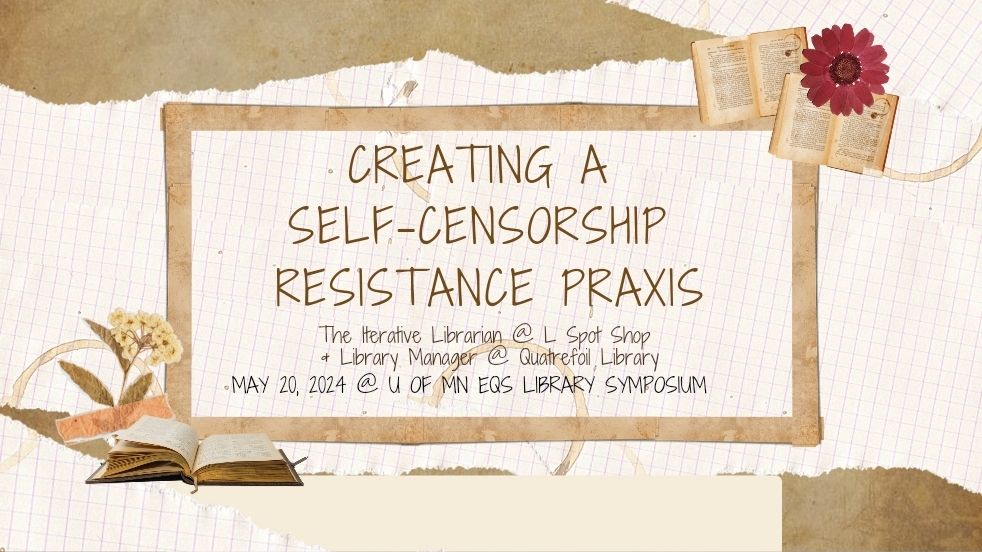
Presentation: Creating a Self-Censorship Resistance Praxis
The day we all gathered together at Hubert H. Humphrey School of Public Affairs was the same day the MinnPost published the article about South Dakota Board of Regents’ onerous signature policy. I don’t think the attendees had heard the news story. When I shared the news, the faces in front of me appeared as if they had seen the Reaper—which was understandable. The Regents’ decision to compel staff to remove language regarding pronouns and tribal affiliation is a massive win for rewinding the clock and sending a message to everyone in academia to be wary, to self-censor, to commit erasure. It was a reflective and somewhat subdued, yet heartfelt, opening.
Introduction

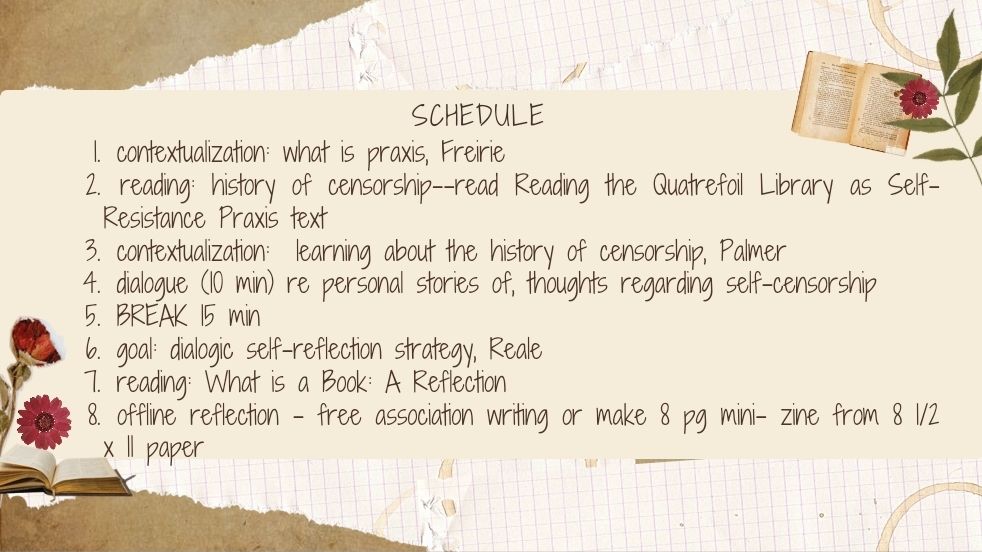
presentation Schedule
PAULO FREIRE’S DEFINITioN OF PRAXIS
praxis – action that is informed (and linked to certain values). Dialogue wasn’t just about deepening understanding – but was part of making a difference in the world. Dialogue in itself is a co-operative activity involving respect. The process is important and can be seen as enhancing community and building social capital and to leading us to act in ways that make for justice and human flourishing.
Smith, M. K. (1997, 2002) ‘Paulo Freire and informal education’, The encyclopedia of pedagogy and informal education. [https://infed.org/mobi/paulo-freire-dialogue-praxis-and-education/. Retrieved: July 1, 2024
I. We will begin by situating ourselves within Paulo Freire’s transformative framework of ‘liberation is a praxis’. A Brazilian educator and philosopher, Freire’s influential work in critical pedagogy revolutionized educational theory. Freire’s most famous work, “Pedagogy of the Oppressed” argues for an education that empowers people to critically examine their world and take action to change it, rather than passively accepting it.
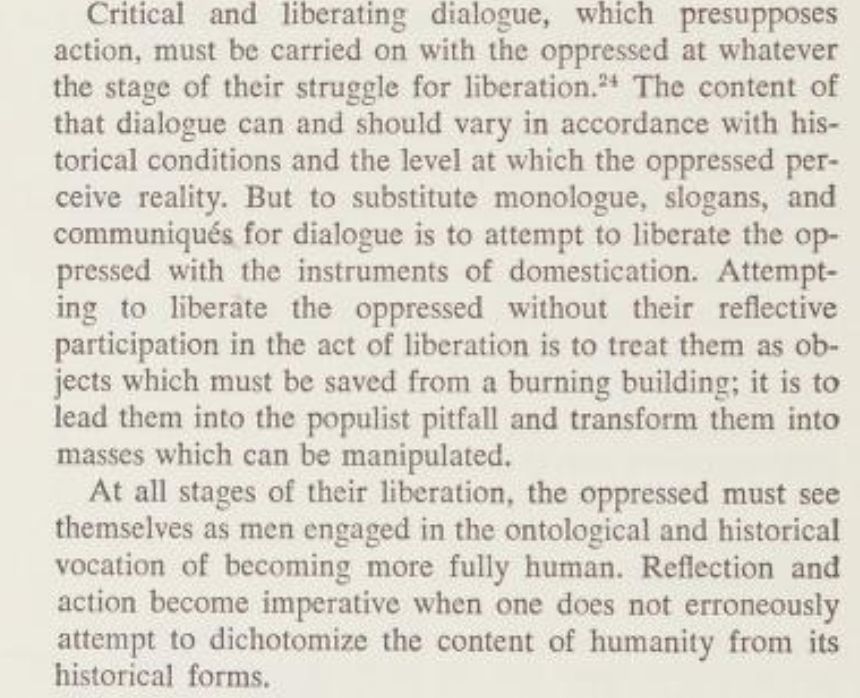
Freire, P. (1972) Pedagogy of the Oppressed, Herder and herder.
Let’s model our work on Freire’s concept—we’ll position ourselves within the framework that upholds ‘self-censorship resistance is a praxis’.
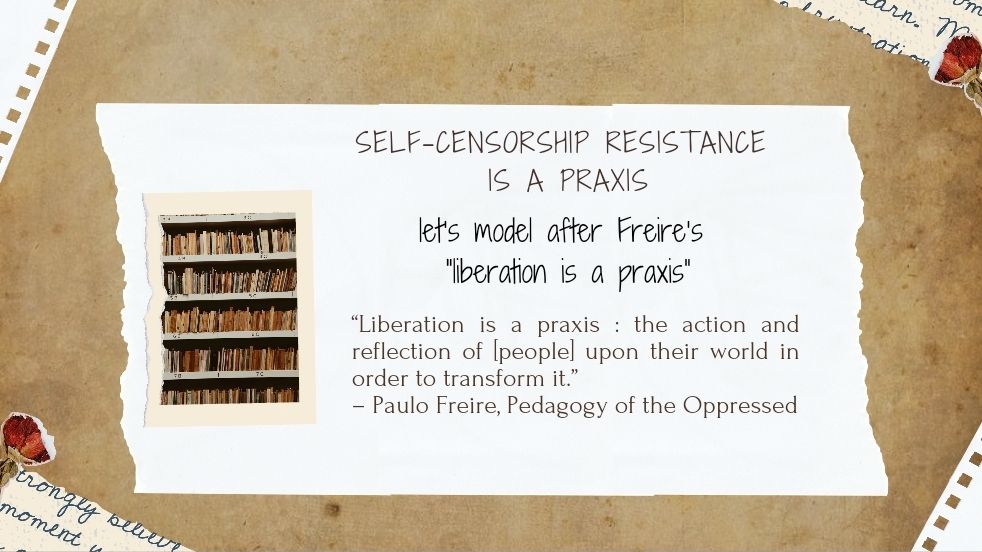
You know, I think Freire would really appreciate what we are doing today—he was all about intentional engagement, dialogue, and reflection that catalyzes action! My hope is that our work together will spark thinking and actions that transform the world.
Isn’t this ideally the project of a library? In their finest form, libraries foster a vibrant exchange—where ideas are discussed, knowledge is shared, and different perspectives are heard. This creates understanding and empowerment, promoting reflection and critical thinking that opens pathways for social justice and meaningful change.

This active engagement and fortification exemplify why books and libraries face perennial opposition—they serve as vital centers of collective knowledge and capacity-building, providing accessible resources and equipping individuals with resources to interrogate and challenge prevailing norms.
reflection (take a minute and maybe jot down your thoughts…)
When I contemplate Freire’s conviction that ‘liberation is praxis’—the active reflection and action of individuals to transform their world—I’m compelled to reassess many of my own assumptions and change how I move through the world.
How does Freire’s concept of liberation is a praxis impact you? Does it resonate with the way we approach our work to address the issue of self-censorship? How do you think this idea might change your approach to librarianship?

Recommended Reading
Mindfulness in Libraries (Press Reader, 2023)
Upcoming: 2. Reading the Quatrefoil Library as Self-Censorship Resistance Praxis
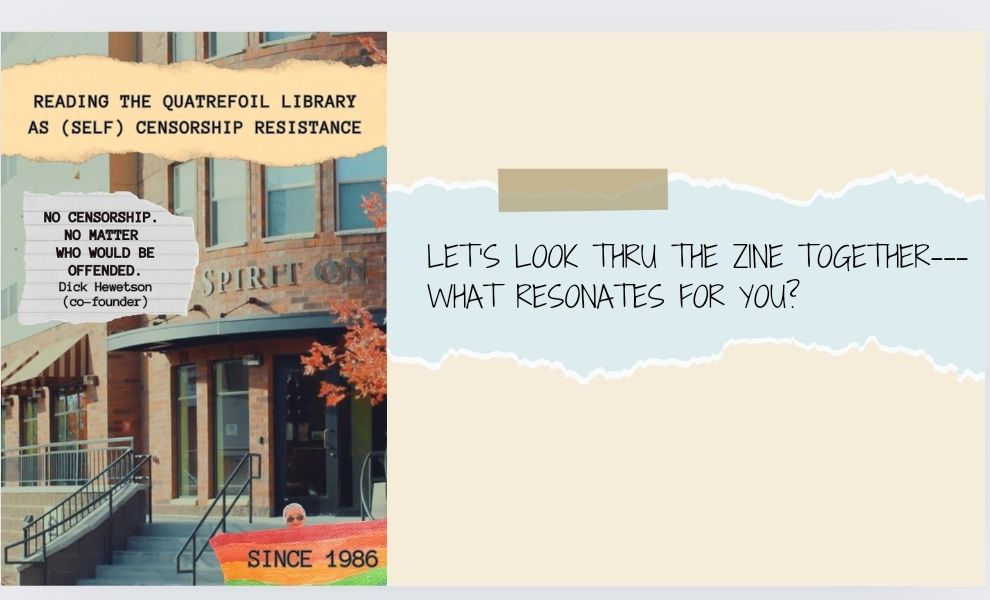
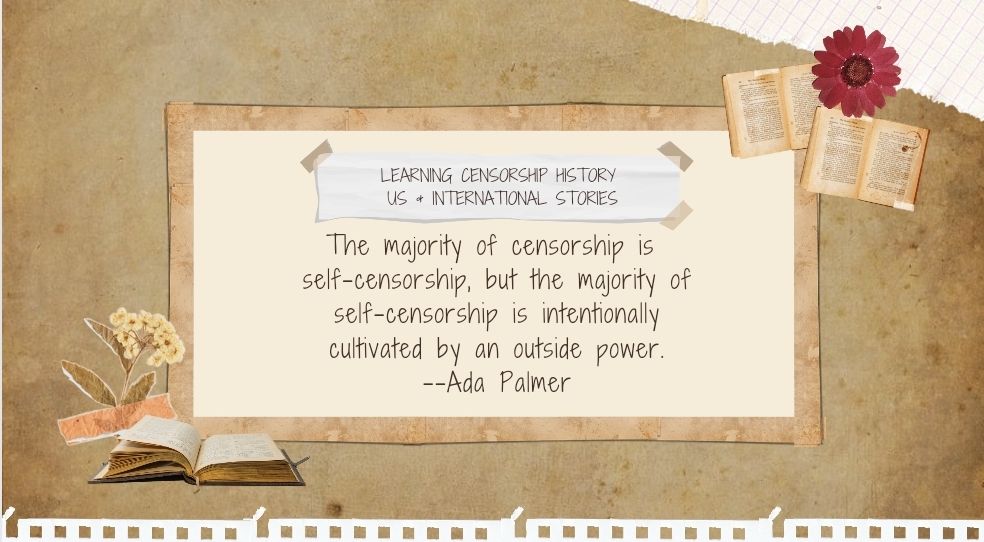
and 3. learning censorship history
 The L Spot Shop
Leave a comment